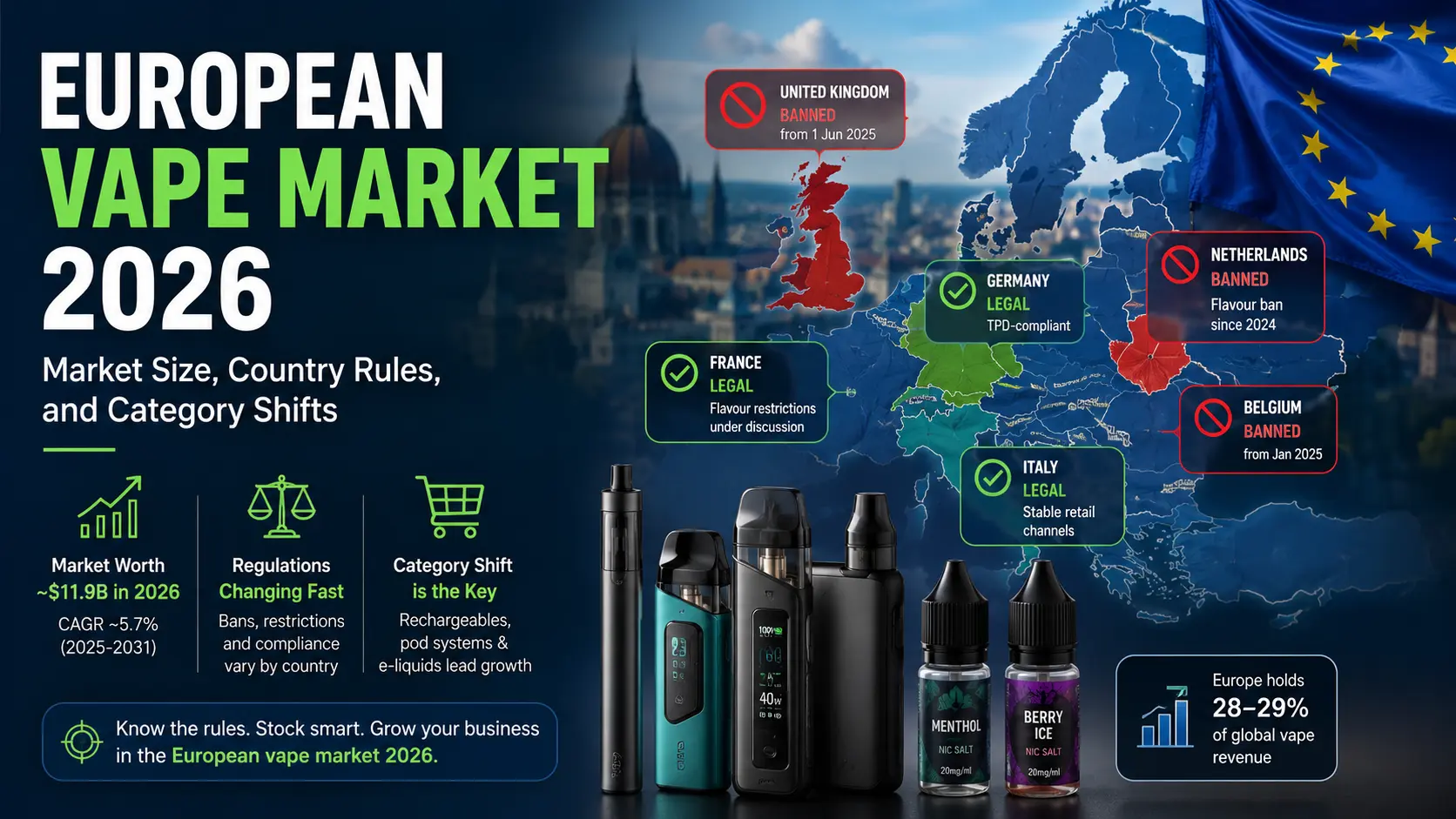
If you run a vape shop or sell vaping products online in Europe, the European vape market 2026 is not the same market you operated in a year ago. One country after another has changed the rules, the product mix has shifted under your feet, and the buyers walking into your store have different expectations. This guide gives you the full European vape market 2026 picture in one place: the size of the opportunity, a country-by-country map of what you can legally stock, the three turning points that define this year, and the category shifts that determine what you should be ordering.
European Vape Market 2026: How Big Is It?
Estimates for the European vape market 2026 vary by research house, and it is worth being honest about that: some put the region at just under $12 billion for 2026, while others quote higher figures using wider definitions that include adjacent product categories. The number that matters for a retailer is not the exact figure but the direction. Every credible source agrees on the same three facts about the European vape market 2026: Europe accounts for roughly 28-29% of global vape revenue, the market is still growing at a low-single-digit to mid-single-digit rate, and the growth is now unevenly distributed across product categories.
To give you a concrete anchor: one widely referenced analysis values the European market at around $11.2 billion in 2025, rising to approximately $11.9 billion in 2026 and projected to reach about $15.7 billion by 2031. That is a compound annual growth rate near 5.7% — steady, but no longer the explosive double-digit growth of the late 2010s. In the European vape market 2026, growth comes from winning share and pivoting categories, not from a rising tide that lifts every product.
What does this mean for you operationally? It means you cannot rely on market growth to fix a slow-moving product line. The money is moving toward specific categories and specific countries, and this guide maps exactly where.
The One-Page Country Map: Where to Sell What in the European Vape Market 2026
This is the section that saves you from ordering the wrong stock. Before you place a single purchase order, know your channel. Online-only retailers face different realities than brick-and-mortar shops: an e-commerce store selling across the EU must track the rules of every country it ships to, while a physical shop only needs to satisfy one jurisdiction. This split is why we see two distinct buying patterns in the European vape market 2026 — cautious cross-border e-commerce orders that favour fast-moving, widely legal lines, and more experimental domestic orders that can afford to test niche products. The rest of this guide treats both models, and the country table below is the reference point you should pin above your desk. The regulatory picture across Europe in 2026 is a patchwork, and stocking decisions must start with what is legal to sell in your country or your customers’ countries. Here is the European vape market 2026 country map in one table:
| Country | Market size (2025 est.) | Disposable vapes | Key alternative / opportunity |
|---|---|---|---|
| United Kingdom | $3.4B (largest) | Banned from 1 Jun 2025 | Rechargeable pod systems, refillable kits, e-liquid |
| Germany | $1.8B | Legal (TPD-compliant) | Premium pod systems, quality-focused hardware |
| France | $1.3B | Legal (flavour restrictions under discussion) | Nicotine-salt pod systems, high-puff rechargeables |
| Italy | $195M | Legal | Stable retail channels, established brands |
| Belgium | — | Banned from Jan 2025 | Rechargeable devices, e-liquid |
| Netherlands | — | Banned (flavour ban since 2024) | Tobacco-flavoured products only, refillables |
| Poland / Czechia / Romania |
Three more observations on this map before you move on. First, the Nordics: markets like Sweden and Denmark have mature vape sectors with strong menthol penetration — over 40% in several Nordic markets — which tells you to range menthol variants seriously there. Second, Spain remains a high-volume market where TPD-compliant disposables and high-puff rechargeable devices both sell well, but where enforcement and local notification rules have tightened, so documentation from your supplier is not optional. Third, the eastern growth pocket of Poland, Romania and Czechia is the one place where classic single-use disposables still behave like a growth product. If your supplier can ship small volumes quickly, you can test each of these sub-markets without over-committing — which is exactly the logic behind low-MOQ wholesale. — Legal, high adoption Disposables and high-puff devices still growing
Read this table carefully and you will notice the pattern driving the European vape market 2026: the largest market (UK) has banned the product that historically sold the most, while Eastern European markets are still in the growth phase for the same product. A retailer serving customers in different countries — or selling online across borders — is effectively running two different businesses in the European vape market 2026.
The Three Turning Points Reshaping the European Vape Market 2026
Beyond the country map, three structural changes are reshaping the European vape market 2026. If you only remember three things from this guide, make it these.
1. The UK Disposable Ban’s Chain Reaction
The UK banned the sale and supply of all single-use disposable vapes from 1 June 2025 — covering online and in-store sales, and including nicotine-free devices. The ban redirected a massive pool of demand. Industry observers report that over a million UK vapers shifted to alternatives within months. The biggest beneficiary is the rechargeable pod system: prefilled pods that look and feel like disposables but have a rechargeable battery and replaceable pods. The key legal distinction across the UK market is simple: if a device can be recharged or refilled, it is legal; if it is designed to be thrown away after use, it is not.
For wholesalers and retailers, this is a direct buying signal. Products that sit on the disposable side of the line are dead stock in the UK, while rechargeable high-puff devices and pod systems are the growth aisle. Our guide on vape wholesale Europe explains the sourcing side of this transition in more depth.
2. The E-Liquid Tax Wave
The UK is introducing a tax on nicotine-containing e-liquid from October 2026, adding roughly £2.20 per 10ml. This is the first significant vape-specific tax in the region, and it changes consumer economics: yearly costs for a disposable user were estimated at £1,000-£1,200, while refillable kit users typically spend far less. The tax reinforces the same direction as the ban — toward refillable, reusable formats. When consumers feel the price difference, the shift accelerates. Retailers who have already ranged rechargeable options will absorb this transition more comfortably than those still holding disposable-heavy inventory.
3. The Tobacco and Vapes Act 2026
The UK’s Tobacco and Vapes Act 2026 goes further than the disposable ban. It introduces a licensing regime for all vape retailers, tighter age-verification requirements, and is expected to restrict flavoured products through a defined list of approved flavours once secondary legislation is finalised. Tobacco flavour is widely expected to remain available, menthol sits in a more uncertain position, and open-system devices remain legal as hardware. The practical implication for the European vape market 2026: regulatory compliance is becoming a competitive advantage. Retailers and suppliers who can demonstrate they stock registered, compliant products will keep trading; those who rely on grey-area stock will face increasing enforcement risk. This is also why we advise building supplier relationships with traceability — see our guide on how to choose a vape wholesale supplier for the checklist.
What’s Selling in the European Vape Market 2026: The Category Shift
The category mix is the most visible change in the European vape market 2026. Disposables are no longer the default growth engine everywhere; the growth has moved.
- Pod systems are the fastest-growing segment. Multiple sources put pod-system growth in the low double digits — one report cites 12.4% annual growth — as bans push demand into rechargeable formats. This is the single most important category trend in the European vape market 2026.
- High-puff rechargeable disposables are the grey-zone bridge. Devices with rechargeable batteries and replaceable pods are legal in the UK even at high puff counts. Products in the 20K-35K range with rechargeable capability are filling the gap left by classic disposables.
- Classic disposable growth is now Eastern-European. Poland, Romania and Czechia still show strong disposable adoption and lower regulatory pressure. For wholesalers serving these markets, disposables remain a volume play.
- E-liquid and accessories are steady revenue. As device sales shift to reusable formats, e-liquid and replacement pods become recurring purchase lines — arguably the most predictable revenue in the European vape market 2026.
- Big brands concentrate the market.
- E-liquid is where the margin stabilises. As hardware moves to reusable formats, the repeat purchase moves with it: a customer who buys one pod device returns every few weeks for e-liquid and replacement pods. Retailers who treat e-liquid as a core category rather than an afterthought build a recurring revenue base that device sales alone cannot provide in the European vape market 2026.
- Accessories are low-risk revenue. Coils, batteries, tanks and carrying cases face none of the flavour restrictions that apply to liquids and devices. For shops diversifying away from regulatory exposure, accessories are the steadiest aisle in the store — they are restricted by neither flavour rules nor device bans.
- Packaging and presentation matter more. With regulation pushing toward plain packaging in some markets, the shelf experience is shifting from loud branding to clear, compliant labelling. Suppliers who can deliver clean, information-dense retail packaging give your shop a visible advantage while keeping you on the right side of local rules.
- Big brands concentrate the market. Geek Bar/Elf Bar hold roughly 28% share, Lost Mary around 18%, RAZ about 12%. Carrying recognised brands reduces your need to explain products to customers, but margins on exclusives and private-label lines are increasingly where retailers defend profitability.
Who Is Buying: The 2026 European Vaper
Knowing who your customer is shapes what you stock and how you talk about it. The consumer profile across the European vape market 2026 is now well documented:
- Adults aged 25-44 make up about 58% of vapers — a mature, working-age demographic, not a teen problem.
- The gender split is roughly 62% male / 38% female and narrowing.
- About 68% of vapers are former smokers who switched — this is a harm-reduction story that still drives public acceptance in most of Europe.
- 45% of consumers stick to preferred brands; brand loyalty is increasing.
- 72% research products online before purchasing — your product pages and reviews matter as much as your shelf.
- Western European vapers increasingly prefer refillable pods for cost efficiency; Eastern European buyers remain price-sensitive and value-driven.
- Menthol penetration exceeds 40% in Nordic markets; fruit flavours remain popular but face rising restrictions.
- Menthol penetration exceeds 40% in Nordic markets; fruit flavours remain popular but face rising restrictions.
- Seasonality still exists: summer and festival periods lift portable, high-puff devices, while winter months favour pod systems and indoor use. Smart retailers smooth this by carrying both and shifting display weight.
- Price sensitivity is regional. Eastern buyers respond to value packs and multi-buy offers; Western buyers will pay more for a recognised brand and a cleaner experience.
- Repeat-purchase behaviour favours shops with stock consistency. When a customer’s preferred flavour is out of stock twice in a row, that loyalty transfers to the competitor across the street — one more reason to keep best-sellers reliably in stock.
What This Means for Retailers: A 2026 Action Checklist
Reading about the European vape market 2026 is useful; acting on it is what matters. Here is the checklist we use with our own retail customers:
- Audit your range against the legality map. Flag every SKU that is banned in a market you serve and replace it before enforcement lands.
- Re-balance toward rechargeable. If your inventory is still heavy on single-use disposables, shift budget toward rechargeable high-puff devices and pod systems — that is where demand is moving.
- Add recurring lines. E-liquid, replacement pods and accessories give you repeat purchases instead of one-off device sales.
- Range recognised brands plus one differentiator. Carry brands customers already know, and one exclusive or emerging line to protect margin.
- Prepare for the October 2026 tax. Model your pricing for e-liquid tax so you are not caught adjusting prices reactively.
- Verify supplier compliance. Stock only from suppliers who provide proper documentation. This protects you from seizure risk and from counterfeit product complaints.
- Start with small orders on new lines.
- Range by country, not by habit. If you sell across borders, build separate range lists for UK, Western EU and Eastern EU rather than one generic catalogue. The European vape market 2026 rewards geographic precision.
- Negotiate restock speed, not just price. A supplier with EU warehouse stock can turn an order in days rather than weeks. In a market where regulations change quickly, restock speed is a risk hedge — you want to adjust your range before demand shifts, not after.
- Keep a compliance file per SKU. For every product you stock, keep the registration and specification documents on file. Trading Standards and national authorities in several countries are auditing retailer records, not just shelf stock; having the paperwork ready separates a professional operation from a vulnerable one.
- Start with small orders on new lines. There is no reason to bet the shop on an unproven SKU. Small MOQ sourcing lets you test demand first — the same logic applies whether you are ordering from us or anyone else.
The 2026-2027 Outlook: Where Growth Goes Next
Looking past this year, the direction of the European vape market 2026 is clear. Growth will concentrate in rechargeable pod systems, in Eastern European disposable markets, and in e-liquid and accessories as recurring revenue. Western markets will keep tightening regulation — expect more flavour restrictions and licensing requirements, not fewer. On the supplier side, the same trends mean you should be asking different questions in 2026: Where is your stock physically located? How fast can you replace a recalled SKU? Can you provide documentation for every line you ship? Suppliers who answer confidently become partners, not just vendors. If you are evaluating who to work with, our guide on how to choose a vape wholesale supplier lists the questions worth asking before the first order.
The practical takeaway from the European vape market 2026 is that the retailer advantage has shifted from “who has stock” to “who has the right stock, legally.” The winners this year will be shops that read the country map, re-balance toward rechargeable and pod categories, and build supplier relationships they can rely on when the rules change again. That is a plan you can execute without waiting for anyone — start with a range audit, test new lines at low volume, and let the European vape market 2026 tell you what your customers actually buy. If you are new to buying, our guide on how to buy vape wholesale walks through the ordering process step by step, and our piece on small MOQ vape wholesale explains why low-minimum orders protect a young shop while it learns what actually sells. When you are ready to act, our wholesale range covers the categories this guide points to, from rechargeable high-puff devices to pod systems, all shipped from EU warehouse stock.
Frequently Asked Questions
Q: How big is the European vape market in 2026?
A: Estimates for the European vape market 2026 range from roughly $11.9 billion to higher figures depending on the definition used. All major sources agree Europe represents about 28-29% of global vape revenue and is growing at a low-to-mid single-digit annual rate.
Q: Are disposable vapes banned in Europe?
A: Not uniformly. The UK banned single-use disposables from 1 June 2025 and Belgium from January 2025; the Netherlands banned flavoured disposables (tobacco flavour only) since 2024. Germany, France, Italy and most Eastern European markets still allow TPD-compliant disposables.
Q: What is replacing disposable vapes in the UK?
A: Rechargeable pod systems and refillable kits are the main replacements. Prefilled pod devices that look like disposables but have rechargeable batteries and replaceable pods are legal, and demand has shifted toward them rapidly.
Q: Is there a vape tax coming in 2026?
A: The UK introduces a tax on nicotine-containing e-liquid from October 2026 at approximately £2.20 per 10ml. Other EU countries are monitoring this; further tax measures are expected across the region over time.
Q: Which vape category is growing fastest in Europe?
A: Pod systems are the fastest-growing segment, with some reports citing around 12% annual growth, driven by disposable bans pushing users toward rechargeable formats.
Q: How should a retailer prepare for 2026 regulation changes?
A: Audit your range against legality, shift inventory toward rechargeable devices and e-liquid, model the October tax into pricing, and stock only from suppliers who provide compliance documentation. Starting with small orders on new lines reduces risk.
Q: Which European markets still have strong disposable demand?
A: Poland, Romania and Czechia still show high disposable adoption with relatively lighter regulation, making them growth markets for classic disposable volume. Western markets have largely moved toward rechargeable formats.
Q: How do I choose a supplier for 2026?
A: Look for EU warehouse stock for fast delivery, low MOQ to test demand, documented compliance, and recognised brands in your market. A supplier that offers all four reduces your risk across the full buying cycle.