Most vape shops fail at the pricing table, not the sales counter. You can sell plenty of devices and still lose money every month if your vape wholesale pricing is wrong. The invoice price you pay is not your real cost, the price on your shelf is not your real margin, and a supplier that looks cheap can quietly be the most expensive option in Europe. This guide walks through vape wholesale pricing from first principles: what the three margin numbers actually mean, how to calculate the true cost of every unit, which product categories carry the best margins, how to set retail prices that beat competitors without giving away profit, and finally how to find your break-even point. It is built for European shop owners, so every example uses euros, realistic EU warehouse costs, and the small-order reality of a 50-piece minimum. By the end you will be able to run the numbers on any supplier quote in ten minutes — and know exactly what to sell it for.
The stakes are higher than most owners realise. A mistake in vape wholesale pricing of €0.50 per unit costs you €300 a month on a 600-unit volume — €3,600 a year. And if you are new to the wholesale side entirely, our complete introduction to vape wholesale Europe explains how the market and the buying process work before you worry about margins. That is the difference between a shop that grows and a shop that struggles. Getting your pricing right does not require an accounting degree; it requires a repeatable process, and that is what this guide gives you. Whether you are opening your first shop or replacing an underperforming range, the same vape wholesale pricing framework applies: know your true cost, price with a target margin, and check your break-even before you commit to any order.
Why Vape Wholesale Pricing Determines Your Survival
Retail revenue looks identical across shops; profit does not. Two shops selling the same disposable at the same retail price can have completely different results because one bought at €3.20 landed and the other at €4.10. That €0.90 gap is the entire difference between a healthy margin and a losing line. In a category where price pressure is constant and customers compare across stores and websites, the shop that wins is the one that understands vape wholesale pricing better than its neighbours — not the one that simply charges less.
Pricing also protects you from the two classic traps. The first trap is pricing from the invoice price alone, which ignores freight, payment fees, losses, and taxes — you think you have 50% margin but you actually have 30%. The second trap is chasing the cheapest supplier, which usually means higher MOQs, longer delivery, and more dead stock that eventually gets discounted away. Both traps are avoided with the same discipline: a written vape wholesale pricing process that you apply to every order. That process is exactly what follows, step by step.
The Three Numbers That Decide Your Profit
Every pricing decision comes down to three numbers, and confusing them is the most common error in vape wholesale pricing. Gross margin is the percentage of your selling price you keep after the cost of the goods themselves. Net margin is what you keep after every cost — rent, staff, utilities, card fees, marketing. Markup is the percentage you add to your cost to set the price. The critical difference: margin is calculated on the selling price, while markup is calculated on the cost. A 50% markup is only a 33% margin, and many shop owners have been badly misled by confusing the two.
The practical rule is to plan around gross margin, because it is the number you control directly through vape wholesale pricing and retail pricing. If the wholesale-versus-retail relationship is new to you, our guide to vape wholesale vs retail explains how the two sides of your business fit together. Net margin is what tells you whether the whole business works. As a starting target, most healthy European vape shops aim for a gross margin between 40% and 55% on devices, and higher on accessories and e-liquids. If your gross margin is below 35%, you are almost certainly underpricing or overpaying — and you will find it hard to cover fixed costs. If it is above 60%, you may be leaving demand on the table and letting competitors undercut you. The sweet spot depends on your location and product mix, but the framework to reach it is universal.
True Cost Per Unit: Beyond the Invoice Price
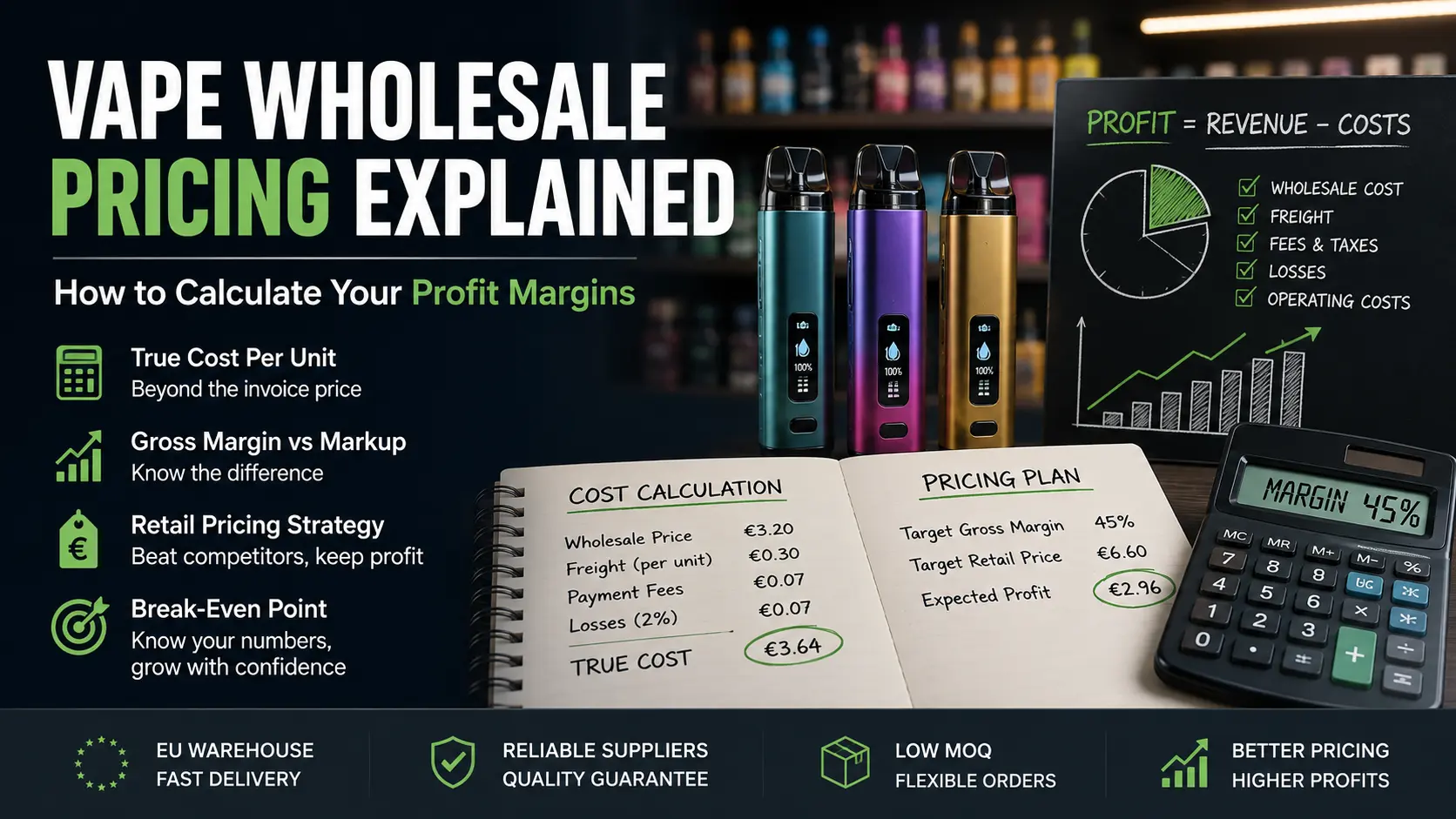
Before you can price anything, you need the true cost of getting one sellable unit onto your shelf. The wholesale price on the invoice is only the start. Add the freight share: divide your total shipping by the number of units received, because a €90 delivery on 300 units is €0.30 per unit. Add payment processing: card and gateway fees typically run 1–2% of the amount you pay. Add expected losses: a realistic 1–3% for damaged units, dead-on-arrival devices, and slow stock that will eventually be discounted. And if your market applies taxes or excise on vape products, include that too, either in the unit cost or as a separate line when you set your retail price.
This is the single most valuable habit in vape wholesale pricing: always convert a quote into a true landed cost per unit before comparing it with anything else. A supplier offering €3.00 per unit with no delivery breakdown may cost you €3.55 landed, while a supplier quoting €3.30 with transparent EU warehouse shipping may land at €3.40. The “cheaper” supplier is not cheaper. Payment method also changes the number: bank transfers often carry a flat fee that disappears on larger orders, while card or gateway payments add a percentage that grows with the order value. Fold whichever fee applies into the unit cost so your vape wholesale pricing stays accurate at every order size. When you compare suppliers, compare landed cost only — and if you are unsure how to evaluate suppliers beyond price, our guide on how to choose vape wholesale supplier lays out the ten factors that matter alongside cost.
Vape Wholesale Pricing: A Complete Worked Example
Let us put the framework to work with a realistic order. You buy 300 units of a mid-range disposable at €3.00 per unit from a supplier with an EU warehouse. Delivery is €90, so the freight share is €0.30 per unit. Payment processing at 1.5% adds roughly €0.05. You budget 2% for losses and slow stock, which is €0.06 per unit. Your true landed cost is €3.41 per unit.
Now set the retail price. A typical street price for this class of device in Europe is €6.99–€8.99. At €7.99, your gross margin is (€7.99 − €3.41) ÷ €7.99, which is 57.3%. Even at a promotional €6.49, you still hold a 47.5% gross margin. That is the power of accurate vape wholesale pricing: the same order looks marginal if you calculated from the €3.00 invoice price and a 30% markup, but it is genuinely healthy when you price against true cost. The difference is not the market — it is the calculation.
For a lower-volume test, the same maths works with a 50-piece order. On 50 units with a €45 delivery, the freight share jumps to €0.90 per unit, landing cost at €4.04. At a retail price of €7.99, margin is still 49.4% — lower than the big order but comfortably healthy, which is exactly why a small MOQ vape wholesale model lets new shops test products without eroding their margin. Start small, verify the numbers, then scale the order sizes that work.
Profit Margins by Product Category
Not every product earns the same margin, and smart vape wholesale pricing means knowing which categories deserve your shelf space. Based on typical European wholesale and retail price levels, here are realistic gross margin ranges by category:
| Category | Typical Landed Cost | Typical Retail | Gross Margin Range |
|---|---|---|---|
| Entry disposables (5K–10K puffs) | €2.20–€3.00 | €5.99–€7.49 | 50–60% |
| Mid-range disposables (15K–25K) | €3.00–€4.00 | €7.99–€9.99 | 50–62% |
| Flagship smart devices (30K+) | €4.50–€6.50 | €12.99–€16.99 | 55–65% |
| Closed pod systems & kits | €6.00–€9.00 | €19.99–€29.99 | 55–70% |
| E-liquids & coils | €1.50–€2.50 | €5.99–€8.99 | 60–75% |
| Accessories (batteries, chargers, cases) | €0.80–€2.00 | €4.99–€9.99 | 70–85% |
Three patterns stand out. First, higher-puff and higher-value devices carry wider margins because customers compare them less aggressively on price. Second, consumables — e-liquids, coils, pods — are your margin engine: they are repurchased constantly and priced less competitively than devices. Third, accessories are the quiet winners, often clearing 70%+ margin with tiny storage cost. A shop that balances its range across these categories smooths out the volatility of any single line and protects overall profit even when one supplier’s vape wholesale pricing moves against you.
How to Set Retail Prices That Win and Still Profit
Pricing to the market and pricing to your costs are not in conflict — they meet in the middle. Start from your true cost and your target gross margin to find your price floor. Then check the market: what do competitors charge for the same or comparable devices in your area? If your floor is below the market, price near the market level and bank the extra margin. If your floor is above the market, you are buying too expensively or the category is saturated — fix the sourcing, not the price.
A workable rule used by successful shops: anchor most devices at 5–15% below the most visible competitor to win the walk-in, while holding accessories and e-liquids at their full healthy margin to recover the difference. Bundle deals — device plus e-liquid or extra coils — protect the device price while lifting the basket value. And always price in multiples of the psychological points your local market expects (ending in .99 or .49). None of this works without the cost discipline behind it, so run every decision through your vape wholesale pricing numbers before it reaches the shelf.
Tiered Pricing & Volume Discounts: Buy Smarter, Not Cheaper
Wholesale suppliers price in tiers, and those tiers are a lever you should pull deliberately. A typical structure lowers the per-unit price as order size climbs — 50 units at one price, 200 units lower, 500 units lower still. The mistake is buying to hit a tier you cannot sell through, just to secure the discount. The discount is real only if the stock moves at full price; dead stock that gets discounted later erases the saving and more. The smarter move is to map each tier’s landed cost against your realistic sales rate and choose the tier that maximises margin per unit sold per month, not the tier with the lowest price per unit.
Volume discounts matter for a second reason: they change your margin at the same retail price. If your supplier drops the landed cost from €3.41 to €3.05 at a higher tier, your margin at €7.99 rises from 57% to 62% — without changing anything your customers see. That is the quiet upside of good vape wholesale pricing over time. Grow into higher tiers as your sales prove themselves, and treat the tier table as part of your pricing review, exactly as you would treat a price list. One practical approach is to run two or three of your best-selling lines at a higher tier and keep experimental lines at the low MOQ tier — you capture the discount where volume is certain and keep flexibility where demand is unproven. That mix is what makes tiered vape wholesale pricing work for a real shop instead of only on paper.
How to Calculate Your Break-Even Point
The last number every owner needs is the break-even point: how many units you must sell to cover your fixed costs before you start making money. It is simple to calculate once you have your gross margin per unit. Start with your monthly fixed costs — rent, salaries, utilities, software, insurance. Divide that total by your gross profit per unit (retail price minus true landed cost). The result is the monthly sales volume at which you break even.
Example: fixed costs of €4,000 per month and a gross profit of €4.58 per device (€7.99 retail − €3.41 landed) gives a break-even of roughly 873 units per month. The formula is simply fixed costs divided by gross profit per unit — you can run it in a spreadsheet in two minutes, and you should rerun it whenever your rent, staff costs, or landed costs change. Sell 900 and you profit; sell 700 and you lose money every month despite positive-looking sales. This single number tells you how aggressive your vape wholesale pricing and retail pricing need to be, and whether a new product line can realistically pay for itself. Run it before signing any large order — it is the fastest protection against overstocking that your margin will ever have.
Vape Wholesale Pricing Mistakes That Eat Your Margin
Most margin loss is avoidable and comes from a handful of repeatable errors. Confusing markup with margin tops the list — a 50% markup is not a 50% margin, and pricing to a markup belief quietly shrinks profit. Ignoring freight is second; a €0.30–€0.90 per-unit delivery charge can wipe out a thin margin. Not budgeting for losses and slow stock means the first discount cycle eats the year’s profit. Forgetting taxes until checkout forces last-minute price cuts. And comparing suppliers on invoice price instead of landed cost keeps you overpaying indefinitely.
The fix for every one of these is the same habit: a one-page vape wholesale pricing sheet per order — invoice price, freight, fees, losses, taxes, true landed cost, target retail, margin check. Review it against the category benchmarks above, and keep a record so you can see which lines actually earn their place. If a product cannot clear your minimum margin after honest costing, either the supplier or the product has to change. For the full process of ordering and receiving your first shipments under a disciplined cost framework, our guide on how to buy vape wholesale covers the end-to-end steps.
Frequently Asked Questions
Q: What is the difference between markup and margin in vape wholesale pricing?
A: Markup is the percentage added to your cost to set the price. Margin is the percentage of the selling price you keep. Because they are based on different denominators, a 50% markup equals only a 33% margin. Plan with margin, because it tells you what you actually keep from every sale.
Q: What is a good profit margin for a vape shop?
A: A healthy gross margin is usually 40–55% on devices and 60–75% on e-liquids, coils, and accessories. Below 35% gross on devices, most shops struggle to cover fixed costs. Exact targets depend on your rent, staff, and local pricing, so use your break-even calculation to confirm your own number.
Q: How do I calculate the true cost of a vape product?
A: Start with the invoice wholesale price, then add the freight share (total shipping ÷ units), payment fees, a 1–3% allowance for losses and slow stock, and any applicable taxes. The sum is your true landed cost per unit. Always compare suppliers on this number, never on the invoice price alone.
Q: Should I buy bigger orders to get better vape wholesale pricing?
A: Only if the stock can sell through at full price within a reasonable time. Buying to hit a discount tier creates dead stock, which gets discounted later and erases the saving. Map each tier’s landed cost against your sales rate and pick the tier that maximises profit per unit per month, not the lowest price per unit.
Q: How do taxes affect my margin calculation?
A: Taxes change the denominator. If VAT applies, compare net-to-net: convert your gross retail price to net, subtract your net landed cost, and only then calculate margin. Countries across Europe differ in rates and excise treatment, so build the local tax rules into your vape wholesale pricing sheet before you set retail prices.
Q: How many units do I need to sell to break even?
A: Divide your monthly fixed costs by your gross profit per unit. For example, €4,000 in fixed costs with €4.58 gross profit per device means roughly 873 units per month. This number tells you whether a product line or your whole shop is viable at your current pricing.
Q: Which vape products have the highest margins?
A: Accessories (70–85%), e-liquids and coils (60–75%), and pod systems or kits (55–70%) typically carry the highest gross margins. High-puff and flagship devices also support strong margins because customers compare them less on price. Mixing categories smooths your overall profit.
Q: How often should I review my vape wholesale pricing?
A: Review every time a supplier changes a price list, at least once a quarter, and before every significant order. Landed costs move with freight, exchange rates, and taxes. A quarterly review keeps your margins honest and catches a creeping cost increase before it becomes a permanent leak.
Price to Win, Price to Stay
Pricing is not a one-time decision — it is a system. Apply the three margin numbers, calculate true landed cost on every order, use the category benchmarks to build a balanced range, set retail prices against both cost and competition, and check your break-even before committing capital. Do that consistently and your vape wholesale pricing stops being guesswork and becomes the quiet engine that funds growth, covers mistakes, and keeps your shop profitable in a market where many others are cutting prices and cutting their own throats.
If you want a supplier whose pricing structure makes healthy margins easy — EU warehouse stock, transparent landed costs, a 50-piece starting order to test products, and tiered pricing that improves as your sales grow — browse the VAPEVIN wholesale catalogue and create your business account. Run the numbers from this guide against us before your first order. The best time to fix your vape wholesale pricing was before your first shipment. The second best time is right now.